
As promised yesterday, today I’m going to tell you about how we came to be at such an incredible little spot as well as some of the new friends that added to the experience. Continue reading
As promised yesterday, today I’m going to tell you about how we came to be at such an incredible little spot as well as some of the new friends that added to the experience. Continue reading

Today I’m starting a 5 part series on how, in living for and serving God, blessings come that are over and above those directly related to the work of the Gospel. We’ve experienced it once again and I want to share it with you each day this week…. are you ready?
Let’s go!
Thought I’d break it up a bit today and share part of a neat article that I found on the Fluent U website. (See end of post for details and a link to the original article.)
.
As a French learner, which would you rather hear?
“Your French is so good!”
Or…
“You sound so French!”
If you’re like most people, I’m guessing that it’s the latter.
To help you get there, we’ve racked our brains and put together a list of informal, everyday French phrases and expressions.
Ça roule is a very colloquial statement, meaning that everything’s great and life’s going well. Therefore, in the form of a question, it simply means ‘How’s life? Good?’ Otherwise, the more standard question used to express this same idea is Ça va?, literally meaning ‘is it going?’
For all those who tend to have a dissenting opinion, this casual French phrase is a must. It simply means ‘whatever,’ and is commonly used in French when someone is exasperated and wishes to openly display their disagreement in a simple, informal way.
Example:
“Je te jure! Je n’ai rien fait! » : I swear, I didn’t do anything!
(“N’importe quoi…” : Whatever…)
Similarly, in some other contexts, n’importe quoi can mean ‘anything,’ like in this example:
‘I would have given anything and everyting!’
‘J’aurais donné tout et n’importe quoi !’
This is a useful French phrase, meaning ‘just forget it,’ or ‘never mind that.’ It literally means ‘drop it,’ but doesn’t have quite the same snappy tone behind it as ‘just drop it!’ does in English. Although…it very well can with a spiteful enough tone…
Example:
‘Et alors? Est-ce que tu as eu ton augmentation de salaire ?’
‘Laisse tomber…L’entreprise a fait faillite !’
(So? Did you get your raise? –Forget it…The company went bankrupt!)
Meaning ‘You up for it?’, this casual French expression is great for suggesting outings with friends or restaurant choices. It can also mean, ‘Sound good?’ So, whenever you get a marvelous idea for a Saturday afternoon or evening, tack this on at the end as a way of politely asking your friends if they’re interested. Use the latter when addressing several friends, and the first when hanging out with just one.
Example:
‘Il y a un petit resto chinois pas loin de chez moi…ça te dit?’
(‘There’s a little Chinese restaurant not far from my place…sound good?’)
‘Keep me up to date!’ This is the perfect French phrase to use as you’re waiting to see how things play out in a friend’s life. Perhaps they just started a new job, or moved to a new city, and you want to know how things are evolving. End your emails or conversations with this little phrase to ensure you get those little updates!
Also, inversely, the response to this would be
‘Ouais, t’inquiète pas, je te tiens au courant.’
(‘Yeah, don’t worry, I’ll keep you up to date.)
Bref is only ever used to summarize something or to give one’s final impression of something after a lengthy story has been told, and it’s an easy little word to recall, due to that the English equivalent is almost the same; ‘in brief.’ Another synonyms would be ‘all in all’ or ‘in short.’
Example:
Elle m’a appelé hier et m’a dit qu’elle n’avait pas les mêmes sentiments pour moi, et qu’au final, elle veut qu’on reste amis. Bref, elle m’a largué.
(She called me yesterday and told me that she didn’t have the same feelings for me, and that in the end, she wants to remain friends. In short, she dumped me.)
This casual French phrase is used so commonly in casual settings that it’s almost impossible to have a conversation with friends without hearing it. It simply means ‘Ya know?’ and is oftentimes tacked onto the end of a sentence to emphasize whatever the speaker is saying.
Example:
‘Non, mais j’en ai marre, t’sais?’
(‘No, but I am sick of it, ya know?’)
These are all lovely little French phrases to use to say ‘that sucks!’ or ‘that’s stupid! or ‘that’s terrible!’ The general implication is that whatever is being discussed is either a total bore or totally ridiculous.
Example:
‘Ça, c’est marrant! Par contre, ce cours est nul!’
(‘Now that’s funny! This class, however, sucks!’)
‘It’ll take your mind off things…’ Use this French phrase when consoling a friend who’s down. Offer to go with him/her to a movie or to a café to grab a cappuccino. Make your proposition, then use this argument to get them out of their funk.
Example:
‘Allez! Tu ne peux pas rester enfermé dans ta chambre! Viens avec moi au ciné! Ça te changera les idées !’
(C’mon! You can’t stay cooped up in your room! Come with me to the movie theater! That’ll take your mind off things!”)
‘Doing okay there? You managing there?’ This is a common French phrase to use while observing a friend who appears to be having difficulty doing something.
Example:
‘Tu t’en sors?’
-‘Pas trop, non. Je ne sais pas comment faire un créneau…’
(You managing there? –‘No, not really. I don’t know how to parallel park…’)
.
Note to AIMLong readers:
Note to Original Authors:
Welcome to this, the final Bring it Home post in what has been a bit of a different month. If this is your first time visiting AIMLong.ca, know that it is a blog that discusses short-term missions in general and more specifically, our own preparations for an extended short-term missions assignment in France. March however, has been about how to bring a certain “je’ne sais quoi” to your own home.
(…and why this is even a question)
Terminologically speaking, it can take a bit of getting used to. Look at the terms associated with grapes and a bunch of grapes. I don’t know about you, but the possibility of confusion is definitely there.
| English | French |
| Grapes | des raisins |
| a bunch of grapes | une grappe de raisin |
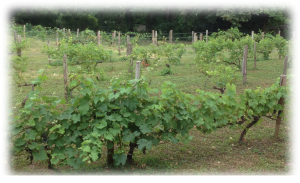 Vineyards are a wonderful spot, but while we tend to think of them in terms of fields and fields at a time (which they often are in France) they can also be found on a much more intimate scale.
The vineyard to the left can be found at the base of the Tour Caesar in the UNESCO World Heritage town of Provins, a fortified medieval hilltop town south of Melun.
 One thing I love about the French though, is this. Use of grapevines is not just limited to full-blown vineyards. Take a look at the house on the right. This is a very young grapevine, but the main stem has been allowed to grow up one of the beams of the house and then lateral branches are encouraged to grow to either side.
Training a grapevine to grow in such a manner has two benefits:
From the time that we first bought our current house (2002) I established 4 grapevines on the property (mostly against the house, but one over an arbor) kept pruned in a couple of ways, but all along the same principle as described above.
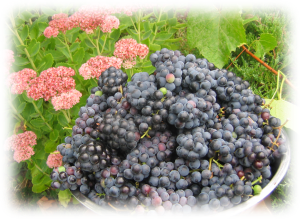 It took a couple of years for them to establish, but in 2012 I harvested over 10lbs of grapes (enough to make 30+ bottles of grape jelly) and when it came time to prune the plants, made several grapevine wreaths for holiday decorating.
Note: you do need to prune grapevines heavily. This will ensure that energy is preserved for growing grapes rather than keeping an excessive number of branches alive.
One last comment on grapes before I end March’s Bring it Home focus.
The reason that I have always particularly liked grapevines is this. In the Bible, when a group of men were going to explore the land that God had promised them… the promised land, they came back carrying grapes. The cluster of grapes was so big that it took two men to carry it on a staff (Numbers 13.23).
The men brought this enormous cluster of grapes to prove a point to those who’d not seen the land with their own eyes. What was it?
This enormous cluster of grapes was tangible proof of the extent of the abundance that characterized God’s provision for his people. Never before had they seen anything like it.
Such is the provision that Jesus’ makes for his people. John 10:10 (Jesus speaking) says this… “I have come that they might have life and that more abundantly.”
You want abundant life?
You’ll find it in Jesus!
The other day, I gave you a few pointers on how to make a visually outstanding cup of coffee. Today, will be another coffee post, but not quite as involved… it will just take a couple of “props” (you’ll see what I mean).
If you’re just picking up the Bring-it-Home series with this post and you’re a coffee drinker, I’d highly recommend heading back to my last (un)Gourmet Coffee post.

As with the coffee in my first (un)Gourmet Coffee post, I don’t recommend starting a wonderful coffee experience with a drip coffee maker. Remember, you’re trying to bring home a taste of France, and when you order un p’tit café it will NOT be drip-coffee… guaranteed!
A good alternative to the expensive “start-to-Finish” espresso machines, like DeLonghi for example, is a simply stove-top espresso maker (Bialetti is a good brand, although there are several). Such a maker will brew you up a great cup of full-bodied coffee. Here’s the quick run-down…
The water goes in the bottom, coffee grounds in the filter (in the middle) then screw the top on, place on the burner and turn to high (remove from burner once you hear the “whoosh” sound, letting you know it’s done.
For today’s coffee there are a couple of options for preparing the milk (if you take milk or cream in your java).
For sweetner… the French will mostly use real sugar (if they’re sweetening at all) and they’ll either use small packets or, if in restaurants / cafés, you could also be given individually wrapped sugar cubes. I also like to sweeten with honey when we have some available.
For today’s treat, I’m not sure that there’s anything magical about preparing the coffee per sé; today it’s all about the presentation. With the exception of Starbucks and similar chains, the traditional p’tit café is served in small little demi-tasses such as the ones pictured below. Don’t worry if you don’t have ones as fancy as these, they just happen to be some of the ones we have, but any demi-tasse cup is great. Also, note that I’m not using frothed milk in any of these photos… I have used it in the demi-tasse and it’s a nice presentation as well, so either way is fine. 
 In France, while it’s encouraged to order dessert with your coffee (you’ll definitely be wowed by SOMEthing!) it’s not particularly necessary as un café will almost without exception be served with un p’tit chocolat… a small, thin chocolate square (usually dark chocolate) on the side.
So in order to bring it home today… pick yourself up a packet of Lindt or Côte d’Or chocolate at your local grocery store and serve it alongside a nice little demi-tasse full of espresso.
Voilà! I hope you enjoy it!
Yet another kitchen-themed “Bring it Home” post for you today… this one, something that probably 98% of you will be able to appreciate and enjoy… (un)Gourmet Coffee.

Quite simply… while it looks like gourmet coffee, it’s really just Maxwell House… all dressed up to look Gourmet!
You have already seen this theme and will see it time and again… French style is as much about details and presentation as it is about something distinctly exotic. In this case… preparation and presentation make all the difference in the world to your first impression one of the most common North American coffee brands.
You can see the foam on top and hot steamed milk at the bottom of the cups… with the coffee floating in the middle.
Brewing the coffee:
First of all, in order to make this coffee truly memorable… do NOT run it through your traditional drip coffee maker. You’ll get weak coffee (or, “jus de chaussettes”) which won’t do justice to the presentation that you will be giving it.
Get yourself one of the little stove-top espresso makers (they are quite easily found in stores) for under $20 (bonus… great espresso look, withOUT the pricey espresso makers that “do it all”).
The water goes in the bottom, coffee grounds in the filter (in the middle) then screw the top on, place on the burner and turn to high (remove from burner once you hear the “whoosh” sound, letting you know it’s done.
Preparing the Milk:
Put about 1″ of 2% or whole milk in the bottom of a clear glass mug (there’s less of a show if you can’t see the separation of the milk and coffee). IF you sweeten your coffee, use a heaping teaspoon of either honey or sweetened condensed milk (to taste) and microwave it for 30-seconds per mug (if doing two at a time… 1 minute).
 When done, remove from the microwave. If by chance a veil has formed on the hot milk, remove it before frothing.
Now you’re set… using a conventional hand-held milk frother (available at most kitchen-ware stores for 10-15$), froth the milk until it’s nice and thick and a good head has formed. Depending on the size of your mug, you may need to adjust the amount of milk a bit… if there’s too much, it may overflow slightly as you begin the frothing process; just tweak as you get used to the strength of your frother and the size of your mugs.
Making the magic:
This part is easier than you might think… honest!
– Begin with your mug of milk (foamed/frothed milk on top, liquid milk below) on the counter.
– Take espresso maker full of brewed coffee in one hand (your most steady hand)
– Take a spoon in your other hand
Your going to insert the spoon, ever so slightly, into the edge of the frothed milk, not far down. The back side of the spoon is facing outward and resting on the side of the coffee mug.
Slowly begin to pour the coffee over the back of the spoon (if you do it too quickly, the coffee and the milk will mix and you won’t get the nice separation-effect). If you do it correctly, the milk at the bottom of the mug will not mix with the coffee. Continue to pour until the foamy, frothed milk reaches the top of the mug.
If you are serving someone else… presentation-wise, it’s always nice to put a spoon in it (a nice tall partfait spoon if you have one). The recipient gets the enjoyment of seeing your coffee-art and stirring the two together.
Simple as that! Once you get the hang of it, it’s really very, very simple and you will find that friends will rarely refuse coffee at your house… even if they’re not normally coffee drinkers.
(Note: if people are not used to espresso and don’t think they’ll like it, let them know that with the milk and sweetening, they’ll be surprised at the “strength” of the coffee).
I hope you enjoy it, let me know how you make out!
Come back Saturday when I’ll have another (un)Gourmet Coffee post; an even more French way to serve coffee.
So it’s time for another Bring it Home post, and I’m taking you back to the kitchen for today… or should I say… la salle à manger (the kitchen or the dining room).

Getting down to the end of a pair of rounds
Raclette is something that I first encountered in Switzerland (which shares the Alps with France, along the eastern border) but which is also readily found in the French Alps as well. It is primarily a cheese and potato dish, but the modern version has gotten more creative, as you’ll see in a bit.
Remember first, that many cheeses were originally made in large rounds… like thick discs or wheels. A common way of eating it in the mountains, on cold winter nights, was to heat up the cut edge and scrape the melted cheese over boiled potatoes, giving a hot and rich dish to warm the insides. The “raclette” was essentially, the tool used to scrape the melted cheese off the top of the round; eventually it lent its name to the dish and even to the cheese used.
It would be a lot of work to (a) get a round of cheese with which to have a raclette these days (not to mention very expensive) and (b) find a machine that would melt the top of the round. Modern versions of appliances do exist but are not readily found in North America.
 Enter the modern raclette appliance. They are quite commonly found (as indicated by the fact that you can even find them in Atlantic Canada!). There are numerous brands available but they all pretty much work on the same principle:
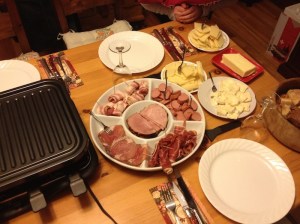 Besides the great taste and hearty meal that a raclette provides, there are at least four other benefits to having a raclette for supper. Because the raclette machine sits in the center of the table:
I suppose you could say that in one way, the French have this whole fellowship thing down to a “T”. They like to eat and they like to eat long! The idea of spending a prolonged amount of time at the table, discussing and interacting with one another is much more common in Europe than it is in North America (generally speaking).
So if you’re looking to Bring it Home a little bit… try picking up a raclette machine, or borrow one from a friend. Then… send the invite out to a few people that you truly love spending time with. Boil some potatoes and prepare your cheese, sliced meats and vegetables and voilà… you are in for a Wonderful evening!
Bon Appétit!
(Enjoy your meal)
<
p style=”text-align:justify;”>
 .
.
.
.
.
.
.
Here’s another post in March’s “Bring it Home” series. This one will add a little ambiance to your decor or romantic moments.
This is how Liz got a light breakfast on Valentine’s Day this year…
- tatted lace hearts
- hardanger heart
- a cinnamon roll (not particularly French in and of itself, although the French are into pastries with their morning coffee)
- Espresso and a chocolate truffle from Maxim’s
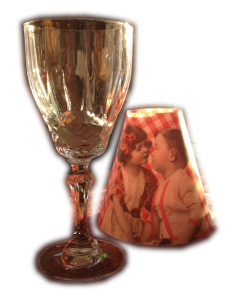
- a romantic-themed lamp… (you will have noticed in the Goose n Cheese on Water post, that a similar lamp graced the table on our dinner cruise)
The Little Things
As is the case with so many things French… it’s not so much in the over-statement as it is in the under-statement… the attention to this or that small detail which adds a finishing touch to the whole.
- shoes, a handbag or a scarf to accessorize an outfit
- garnishes on a plate to give a final touch
(like almond slices on the Îles flottantes)- a small piece of dark chocolate to accompany a demi-tasse of espresso (known as “un p’tit café” or simply “un café”).
Orval Creations:
This lamp in particular comes from French retailer Orval Creations, who market themselves as purveyors of retro vintage decor.
You can see that all it is, is a plastic shade, placed over crystal stemware. What makes it easy to ship, however, is that it comes flat, and you just wrap it into shape.
*see the un-assembled lampshade below*
You can purchase a set of 3 such lampshades for only 3.81 euros ($5.25)…. the only problem is… they will only ship within Europe, so impossible to order directly from their site if you’re in North America.
What to do?
Make your own!
You’ll want to find something that’s rigid enough to hold it’s shape well… a craft supply store would likely have something to fit the bill.
The lampshades shown here have a pattern and graphics on them, however they can just as easily be plain as well (as is the case on the very swanky river cruise).
DIY stemware lampcovers:
- Save-on-Crafts.com
- Postris (they suggest a paper-cup with a cool design and the bottom cut out of it, turned upside down on stemware).
*Note:*
If using paper cups, use the LED tealights… NOT real candles, as the paper cups could catch fire… and nothing kills the romance like having to blast the room with foam or fire-suppressing powder!
(good luck!)
For this third post in the Experience it series we’re going to head out into the Garden and give you a couple of ideas that will help you bring a little bit of France into your yard. Continue reading
This is the second of my Bring it Home series for the month of March… c’mon along for the ride!
This was an experience that I had back in April 2008, long before there was any thought of our AIM appointment and even a couple of months before I’d even met Bro. & Sis. Nowacki for the first time (which would happen in July of 2008).
We were in Europe visiting my wife’s family in Belgium (although she is of Italian descent, she was born and raised in Belgium) and I persuaded my inlaws to babysit the kids for two days, while I whisked Liz away to Paris as a surprise. She knew nothing of the plan except that she needed to pack an overnight bag and would need one nice outfit. Amongst other visits I’d planned, we were going to have an evening dinner cruise aboard one of the Bateaux Parisiens vessels which dock near the foot of the Eiffel Tower..
.
 .
.
 On the Menu
On the menu that night was, among other things, foie-gras (pronounced “fwah-grah”, top-right) served with greens and sauteed mushrooms in a dark sauce, topped with sea-salt and pepper.
If you’ve never had foie-gras before it’s essentially a pâté. The most colourful description I ever heard however, is from Steve Shobert, and bears repeating: “Foie-gras is basically the poached liver of force-fed goose” (doesn’t that just get your mouth watering!). For many north americans it’s an acquired taste, but for the French, it’s an art!
For the main course we had salmon, which was likely delicious, but one thing about the French, they like their cheese as much as they like their foie-gras! Consequently, between the main course and dessert, the plat de fromage (or, cheese plate, above) is a must. This is a particularly joyous part of the meal for my wife as well. When she married me and moved to North America, she went from hundreds and hundreds of different cheeses to white cheddar, orange cheddar and marble cheddar, whose variety extended to mild, medium and old – what variety!
Want to experience a little bit of France at home? One way is to put a bit of foie-gras on the menu and be sure to incorporate some French cheeses in between the main course and dessert.
Foie-gras can be pricey so be aware of that. A little goes a long way… even the French don’t eat huge portions of it, so don’t feel cheap about only serving small portions. As is typical of the French, it’s all about taking something simple and accessorizing it… dressing it up. As for cheeses, find yourself the staples: Brie, Camembert, Roquefort (sharp), Boursin and chèvre (goat), and be sure to serve with a bit of baguette (French Bread).
Well… you’ve got the Goose liver and the cheese. As for the water… if you can’t fit a trip to Paris in the budget just yet, put all of the above in a pic-nic basket and load the canoe onto the car or hitch up the boat-trailer. It won’t be exactly the same, but you’ll feel that certain “Je ne sais quoi” that is typically French as well… I think we also call it, Romance…
 Just for the record, there were a couple other things on the menu as well, one of which is pictured here. Honestly, I haven’t got a clue what it was although it looks like spinach run through a blender with a white sauce burying something…..
What do you think? Would you try it?

 AIM Long