Incredible post … If missions is burning in your heart, you will be able to relate.
Scott Sistrunk: Leadership Moments
The Old Expression…
“Lyghtly whan one wynneth, an other loseth*” is an old English expression from the 16th century that you have likely never heard before, although you’d know it’s modern equivalent:
“One man’s loss is another man’s gain”
That was the case on the last Sunday of March when yet another late-winter (technically early-Spring) storm buffeted the province of New Brunswick, dumping some 45cm of snow in the Perth-Andover area. For this reason, career church-planter Scott Sistrunk, rather than heading north, remained storm-stayed in Saint John after a planned morning service and lunch-learn with local church leadership.
Planned Ministry:

Source: my Instagram Feed: MikeLongSJ
During the morning service Sis. Sistrunk sang and Bro. Sistrunk preached on the 5 people that you will find in every great church.
- an Andrew: whose first thought is to introduce Jesus to someone else.
- an Aquila & Priscilla: who take time to disciple others… showing them “the way more perfectly”.
- a Widow-woman: not literally – but one who gives sacrificially.
- an Agabus: who operates in the gifts of the Spirit.
- a Dorcas: who exudes kindness & good works.
Following an incredible morning service and time at the altar, he shared with our leaders, “The Engine of Church Growth”. Discussing key points and processes that are absolutely in place in every church where growth is occurring (when an organism is healthy… growth occurs naturally), including potential fail points and what some of those processes look like in churches of differing sizes.
Unexpected Ministry:
Given the fact that the Sistrunks would be in town for an extra evening and we were not having service that night, we had the opportunity to have supper together, and by the time we wound down, we were about 15 minutes shy of 3 hours! Where had the time gone?
Bro. & Sis. Sistrunk had been AIMers in South Africa during the mid-1990’s so they could appreciate some of the planning that we were in the midst of as well as some of the questions we had… yet by the same token, they could also relate to the eager anticipation that we feel as well… the desire to lift up the name of the LORD in the land to which we are called, for the time appointed.

September 2013. Source: Instagram, MikeLongSJ
We discussed AIM in general, preparation for such undertakings (spiritually, financially and family-wise), VISION and execution of that vision. There were a couple of “God-moments” during the discussion and doors opened for future connection.
It blows me away that, because of a series of decisions to follow the Lord and His will, I get to rub shoulders with the incredible people that I do on a regular basis (beginning with the local church and it’s leadership).
“Lord, make and mold us after your image so that we can take what you and others have invested in us, and be profitable for your Kingdom.”
Footnote on Rev Scott Sistrunk:
The first time I’d ever heard of the Sistrunks, they were being interviewed by Rev. Carlton Coon on HMLive. (a webcast which has since been renamed Mission North America Podcast). They have spent twenty-seven years in the Metro Detroit area and have planted six churches to-date with a seventh to begin later this month.
If you’ve never heard or seen Bro. Sistrunk minister, check out a few of these links:
- North American Missions’ Director’s Communiqué, March-April 2013 issue (.PDF).
- Podcast on “Change”, from the Westchester Church Podcast, May 2009.
- North American Missions 2009 video (then: HMLive) 11/10/2009.
- Several videos can be found at the here… at the Apostolic Leaders Network, discussing various aspects of Church Planting.
* [c 1527 T. Berthelet tr. Erasmus’ Sayings of Wise Men D1V]
March in Review
Welcome to April!
March was kind of a different month here on the AIMLong blog, featuring posts that had nothing to do with our upcoming short-term mission per sé, but rather simply with how to experience a little bit of France in everyday life. It was also an attempt to expose the blog to a wider audience than to those who already know us or know of our project.
For this first post of April, I want to give you a quick run-down of some of the things that happened in March, which are more directly connected to our AIM term.
Looking back…

Here are some of the highlights of the month that was:
- We mailed out information/support packets to 210 pastors throughout North America, all of which contained
- a pair of our bookmarks to serve as prayer reminders.
- a letter introducing us as a family.
- a PIM form.
- a handwritten note to alleviate the “impersonal form-letter syndrome” which is necessary, but by itself is not quite me.
- We’re grateful to have had 13 of services scheduled: mostly around the Atlantic District, but also in the Quebec, Alabama, Texas and, tentatively, in the Michigan Districts.
For up-to-date details, please see our schedule.
(During the month of May, we will be driving through the Alabama, Florida, Texas & Michigan Districts. If you would like to have us come to your church or know of someone who might like to have us come, please fill out the form below.) - We are extremely grateful for the several pastors who, even without having had us come for a service, have expressed their desire to support us financially and/or support us prayerfully (my next couple of posts will talk about the importance of prayer in laying a foundation for revival).
Our efforts… God’s credit
We are trying to be diligent in our attempts to raise financial and prayer support. We realize however that for whatever comes in, the credit belongs to God. This principle is portrayed in Proverbs 21.31:
The horse is prepared against the day of battle: but safety is of the LORD. (KJV)
The horse is made ready for the day of battle, but victory rests with the LORD. (NIV)
The assurance that “victory rests with the Lord” does not alleviate the necessity of the horsemen to prepare or make ready their horses for the battle. In the words of Duncan Campbell (about whom you’ll read more in the next two posts):
“…while God is sovereign in the affairs of men,
His sovereignty does not relieve men of responsibility.”
Contact Form:


Thank you!
Thank you for your support. Yes. You are showing support simply by the fact that you are coming back time and again to stay informed about our project and preparations. Let it inform your prayer time and be part of the work of God in France.
Not a follower yet?
You can follow by email or in your WordPress reader by clicking the buttons on the top right of this page.
Grapes vs. Raisins
Welcome to this, the final Bring it Home post in what has been a bit of a different month. If this is your first time visiting AIMLong.ca, know that it is a blog that discusses short-term missions in general and more specifically, our own preparations for an extended short-term missions assignment in France. March however, has been about how to bring a certain “je’ne sais quoi” to your own home.
Grapes or Rasins?
(…and why this is even a question)
Terminologically speaking, it can take a bit of getting used to. Look at the terms associated with grapes and a bunch of grapes. I don’t know about you, but the possibility of confusion is definitely there.
| English | French |
| Grapes | des raisins |
| a bunch of grapes | une grappe de raisin |
- Grapes: the French word used to indicate grapes is… “raisins” … how-EV-er, in English, raisins denote a very specific state of grapes… DRIED. In Englihs, dried grapes are called raisins, which begs the question, “What do the French call raisins?” … easy! They call them “des raisins secs” (dried grapes).
- a Bunch of Grapes: Interestingly, the word bunch is translated by a word that looks suspiciously like the English grape… “une grappe”. Interestingly enough though… there is really no particular natural relationship between the two. The French grappe is a botanical term used to indicate a cluster of items that cling to a central stem. Even flowers like lilac, wisteria, foxglove or phlox would be described using the terme grappe.
La Vigne…
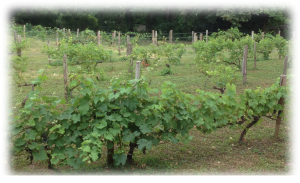 Vineyards are a wonderful spot, but while we tend to think of them in terms of fields and fields at a time (which they often are in France) they can also be found on a much more intimate scale.
The vineyard to the left can be found at the base of the Tour Caesar in the UNESCO World Heritage town of Provins, a fortified medieval hilltop town south of Melun.
 One thing I love about the French though, is this. Use of grapevines is not just limited to full-blown vineyards. Take a look at the house on the right. This is a very young grapevine, but the main stem has been allowed to grow up one of the beams of the house and then lateral branches are encouraged to grow to either side.
Training a grapevine to grow in such a manner has two benefits:
- It softens the hard architectural lines of the house, producing a pleasing, live and green (literally) accent to the decor.
- Once the vine matures and begins to produce grapes (4-6 years), the radiant heat off the facade of the house will ensure that grapes grow big and ripen quickly, ensuring a bountiful harvest.
Bring it Home
From the time that we first bought our current house (2002) I established 4 grapevines on the property (mostly against the house, but one over an arbor) kept pruned in a couple of ways, but all along the same principle as described above.
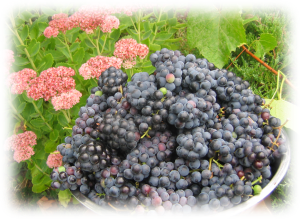 It took a couple of years for them to establish, but in 2012 I harvested over 10lbs of grapes (enough to make 30+ bottles of grape jelly) and when it came time to prune the plants, made several grapevine wreaths for holiday decorating.
Note: you do need to prune grapevines heavily. This will ensure that energy is preserved for growing grapes rather than keeping an excessive number of branches alive.
Provision
One last comment on grapes before I end March’s Bring it Home focus.
The reason that I have always particularly liked grapevines is this. In the Bible, when a group of men were going to explore the land that God had promised them… the promised land, they came back carrying grapes. The cluster of grapes was so big that it took two men to carry it on a staff (Numbers 13.23).
The men brought this enormous cluster of grapes to prove a point to those who’d not seen the land with their own eyes. What was it?
This enormous cluster of grapes was tangible proof of the extent of the abundance that characterized God’s provision for his people. Never before had they seen anything like it.
Such is the provision that Jesus’ makes for his people. John 10:10 (Jesus speaking) says this… “I have come that they might have life and that more abundantly.”
You want abundant life?
You’ll find it in Jesus!
a Scent of Lavender…
It’s hard to believe that March is almost to a close, and with it… the all too soon end of Bring it Home month, where we’ve been discussing how to bring a little bit of France into your home, for way less than the price of airfare!
Today we’re talking…
Lavender

My earliest memories of lavender, I won’t deny it, were of soap in my grandmother’s linen closet and at the time… it wasn’t my favorite smell but on the up-side, when Christmas came ’round, there was no need to second guess what to get gramma… lavender soap was always a safe bet – and economical too (Marks & Spencer here we’d come).
Then, from time to time, you’d also come across lavender sachets tucked neatly away in the back of dresser drawers. A novel concept and, truth be told, a nicer scent than the very perfume-y smell of the soap.
But then, while living in Belgium (1990-1992) I had good friends who frequently vacationed in southern France and they’d tell me about entire fields of lavender (see. pic to the right). In 1995, I got to experience one for myself, in southern France… Magical!
Lavender is pretty much synonymous with southern France. Dried bunches adorn houses inside and out, blossoms are harvested for the perfume and essential oil industries, it inspires artists and fabric designers and finds its way into a great many foodie-dishes!
The first time I was in the market place in southern France and saw “Lavender Honey” I thought… “Marketing Gimmick… just another product to commercialize the region!”
I was wrong.
The bee colonies that call the lavender fields home truly do craft lavender-tasting honey. It’s delicious! (similarly… in areas where there is an abundance of eucalyptus or chestnut trees, the honey takes on those very distinctive tastes as well.)
Bring it Home
It’s no longer uncommon to find lavender plants sold in your local garden center; even in the Maritime Provinces and grows reasonably well here (we’re in a zone 5b). From the time we were married I’ve had lavender growing in the garden. Here are a few things to keep in mind:

- Lavender is very drought tolerant – no need to water a lot once established. Give it as much sun and warmth as you can for best results (this patch to the left is planted on the top of a hillside at the foot of a fence).
- Cuttings from a well established plant can be very easily rooted using an inexpensive rooting hormone (dip the woody end of the cutting into the rooting hormone, shove into the ground – cool semi-shaded spot for 1 growing season – then, when rooted-out, transplant).
- If harvesting the blossoms in bunches, it’s best to do it right before the flower buds open. You can dry bunches by tying the stems together and hanging upside down or work the stems, while still green, into lavender wands using ribbon (here’s a great tutorial on making lavender wands, from Frances over at Fairegarden).
Other uses for Lavender blossoms
Here are a few other things I’ve done with the unopened lavender blossoms (carefully remove the purple flower bud from the stem and the green bud at the base of each flower bud):
*note: ONLY use home-grown lavender for food preparation if you use NO chemicals or pesticides in your garden*
- Homemade Lavender Ice Cream: Place the buds into a saucepan with your milk & cream mixture, heat it to simmering point then strain off the flower buds. This allows the milk mixture to take on the flavour, thus flavouring the ice cream.
- Lavender sugar: Using a new (or well-cleaned) coffee grinder, mix flower buds in with granulated sugar and grind well. This releases essential oils into the sugar, flavouring it.
Note that the ground bits of lavender flowers will still be in the sugar, but they’ll be minuscule, so you won’t notice it… it is edible and adds to the flavour and colour. - Lavender sugar cookies: begin by making lavender sugar as above and use in a basic sugar cookie recipe. (if you ice your sugar cookies, save a few of the unopened lavender buds to use as a garnish)
There are just a few ways to add a taste of southern France to your garden and your home. Stay tuned for our last Bring it Home post this Saturday morning.
(un)Gourmet coffee II
The other day, I gave you a few pointers on how to make a visually outstanding cup of coffee. Today, will be another coffee post, but not quite as involved… it will just take a couple of “props” (you’ll see what I mean).
If you’re just picking up the Bring-it-Home series with this post and you’re a coffee drinker, I’d highly recommend heading back to my last (un)Gourmet Coffee post.
Start with espresso…

As with the coffee in my first (un)Gourmet Coffee post, I don’t recommend starting a wonderful coffee experience with a drip coffee maker. Remember, you’re trying to bring home a taste of France, and when you order un p’tit café it will NOT be drip-coffee… guaranteed!
A good alternative to the expensive “start-to-Finish” espresso machines, like DeLonghi for example, is a simply stove-top espresso maker (Bialetti is a good brand, although there are several). Such a maker will brew you up a great cup of full-bodied coffee. Here’s the quick run-down…
The water goes in the bottom, coffee grounds in the filter (in the middle) then screw the top on, place on the burner and turn to high (remove from burner once you hear the “whoosh” sound, letting you know it’s done.
all brewed… now what?
For today’s coffee there are a couple of options for preparing the milk (if you take milk or cream in your java).
- If you’d like to froth it like last time, go for it, you just won’t need as much of it. Alternatively…
- Simply heat your milk / cream in a small pitcher, prior to adding to the coffee.
For sweetner… the French will mostly use real sugar (if they’re sweetening at all) and they’ll either use small packets or, if in restaurants / cafés, you could also be given individually wrapped sugar cubes. I also like to sweeten with honey when we have some available.
Making the magic… props
For today’s treat, I’m not sure that there’s anything magical about preparing the coffee per sé; today it’s all about the presentation. With the exception of Starbucks and similar chains, the traditional p’tit café is served in small little demi-tasses such as the ones pictured below. Don’t worry if you don’t have ones as fancy as these, they just happen to be some of the ones we have, but any demi-tasse cup is great. Also, note that I’m not using frothed milk in any of these photos… I have used it in the demi-tasse and it’s a nice presentation as well, so either way is fine. 
One More Thing!
 In France, while it’s encouraged to order dessert with your coffee (you’ll definitely be wowed by SOMEthing!) it’s not particularly necessary as un café will almost without exception be served with un p’tit chocolat… a small, thin chocolate square (usually dark chocolate) on the side.
So in order to bring it home today… pick yourself up a packet of Lindt or Côte d’Or chocolate at your local grocery store and serve it alongside a nice little demi-tasse full of espresso.
Voilà! I hope you enjoy it!
(un)Gourmet coffee
Yet another kitchen-themed “Bring it Home” post for you today… this one, something that probably 98% of you will be able to appreciate and enjoy… (un)Gourmet Coffee.
Why (un)Gourmet?

Quite simply… while it looks like gourmet coffee, it’s really just Maxwell House… all dressed up to look Gourmet!
You have already seen this theme and will see it time and again… French style is as much about details and presentation as it is about something distinctly exotic. In this case… preparation and presentation make all the difference in the world to your first impression one of the most common North American coffee brands.
You can see the foam on top and hot steamed milk at the bottom of the cups… with the coffee floating in the middle.
How to do it?
Brewing the coffee:
First of all, in order to make this coffee truly memorable… do NOT run it through your traditional drip coffee maker. You’ll get weak coffee (or, “jus de chaussettes”) which won’t do justice to the presentation that you will be giving it.
Get yourself one of the little stove-top espresso makers (they are quite easily found in stores) for under $20 (bonus… great espresso look, withOUT the pricey espresso makers that “do it all”).
The water goes in the bottom, coffee grounds in the filter (in the middle) then screw the top on, place on the burner and turn to high (remove from burner once you hear the “whoosh” sound, letting you know it’s done.
Preparing the Milk:
Put about 1″ of 2% or whole milk in the bottom of a clear glass mug (there’s less of a show if you can’t see the separation of the milk and coffee). IF you sweeten your coffee, use a heaping teaspoon of either honey or sweetened condensed milk (to taste) and microwave it for 30-seconds per mug (if doing two at a time… 1 minute).
 When done, remove from the microwave. If by chance a veil has formed on the hot milk, remove it before frothing.
Now you’re set… using a conventional hand-held milk frother (available at most kitchen-ware stores for 10-15$), froth the milk until it’s nice and thick and a good head has formed. Depending on the size of your mug, you may need to adjust the amount of milk a bit… if there’s too much, it may overflow slightly as you begin the frothing process; just tweak as you get used to the strength of your frother and the size of your mugs.
Making the magic:
This part is easier than you might think… honest!
– Begin with your mug of milk (foamed/frothed milk on top, liquid milk below) on the counter.
– Take espresso maker full of brewed coffee in one hand (your most steady hand)
– Take a spoon in your other hand
Your going to insert the spoon, ever so slightly, into the edge of the frothed milk, not far down. The back side of the spoon is facing outward and resting on the side of the coffee mug.
Slowly begin to pour the coffee over the back of the spoon (if you do it too quickly, the coffee and the milk will mix and you won’t get the nice separation-effect). If you do it correctly, the milk at the bottom of the mug will not mix with the coffee. Continue to pour until the foamy, frothed milk reaches the top of the mug.
If you are serving someone else… presentation-wise, it’s always nice to put a spoon in it (a nice tall partfait spoon if you have one). The recipient gets the enjoyment of seeing your coffee-art and stirring the two together.
That’s it!
Simple as that! Once you get the hang of it, it’s really very, very simple and you will find that friends will rarely refuse coffee at your house… even if they’re not normally coffee drinkers.
(Note: if people are not used to espresso and don’t think they’ll like it, let them know that with the milk and sweetening, they’ll be surprised at the “strength” of the coffee).
I hope you enjoy it, let me know how you make out!
Come back Saturday when I’ll have another (un)Gourmet Coffee post; an even more French way to serve coffee.
Raclette… a taste of the Alps
So it’s time for another Bring it Home post, and I’m taking you back to the kitchen for today… or should I say… la salle à manger (the kitchen or the dining room).
Traditional Raclette:

Getting down to the end of a pair of rounds
Raclette is something that I first encountered in Switzerland (which shares the Alps with France, along the eastern border) but which is also readily found in the French Alps as well. It is primarily a cheese and potato dish, but the modern version has gotten more creative, as you’ll see in a bit.
Remember first, that many cheeses were originally made in large rounds… like thick discs or wheels. A common way of eating it in the mountains, on cold winter nights, was to heat up the cut edge and scrape the melted cheese over boiled potatoes, giving a hot and rich dish to warm the insides. The “raclette” was essentially, the tool used to scrape the melted cheese off the top of the round; eventually it lent its name to the dish and even to the cheese used.
It would be a lot of work to (a) get a round of cheese with which to have a raclette these days (not to mention very expensive) and (b) find a machine that would melt the top of the round. Modern versions of appliances do exist but are not readily found in North America.
Today’s Raclette
 Enter the modern raclette appliance. They are quite commonly found (as indicated by the fact that you can even find them in Atlantic Canada!). There are numerous brands available but they all pretty much work on the same principle:
- Have some small new potatoes cooked and set aside in a bowl. They can be boiled or broiled, but boiled is the most common. Also, it’s up to you whether you want to peel the potatoes or not.
- Slices of cheese are placed in teflon-coated trays (supplied with the appliance) which slide under an element.
- The element is also covered, on the top, with a teflon-coated grill upon which to cook vegetables, crudités or sliced meats.
- Once the items are cooked to satisfaction you pull out your tray of bubbly-melted cheese and scrape it (using a supplied “raclette” – or scraper) over your potatoes.
What’s more!
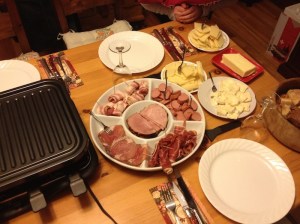 Besides the great taste and hearty meal that a raclette provides, there are at least four other benefits to having a raclette for supper. Because the raclette machine sits in the center of the table:
- …each guest cooks their own supper, meaning that everyone serves themselves the exact portion size and number of servings that they desire.
- …the host or hostess spend the vast majority of their time at the table with their guests as opposed to running back and forth to the kitchen to re-serve helpings of this or that.
- …the meal tends to happen at a very leisurely pace (given that small food items are cooking on the grill and the cheese is melting beneath) so you won’t get the “I ate too much, too fast” syndrome.
- …because of the leisurely pace, a great deal of conversation and interaction tends to happen in between bites or while waiting for things to cook.
French – Fellowship
I suppose you could say that in one way, the French have this whole fellowship thing down to a “T”. They like to eat and they like to eat long! The idea of spending a prolonged amount of time at the table, discussing and interacting with one another is much more common in Europe than it is in North America (generally speaking).
So if you’re looking to Bring it Home a little bit… try picking up a raclette machine, or borrow one from a friend. Then… send the invite out to a few people that you truly love spending time with. Boil some potatoes and prepare your cheese, sliced meats and vegetables and voilà… you are in for a Wonderful evening!
Bon Appétit!
(Enjoy your meal)
<
p style=”text-align:justify;”>
Table decor… lamps
 .
.
.
.
.
.
.
Here’s another post in March’s “Bring it Home” series. This one will add a little ambiance to your decor or romantic moments.
Valentine’s Day
This is how Liz got a light breakfast on Valentine’s Day this year…
- tatted lace hearts
- hardanger heart
- a cinnamon roll (not particularly French in and of itself, although the French are into pastries with their morning coffee)
- Espresso and a chocolate truffle from Maxim’s
- a romantic-themed lamp… (you will have noticed in the Goose n Cheese on Water post, that a similar lamp graced the table on our dinner cruise)
The Little Things
As is the case with so many things French… it’s not so much in the over-statement as it is in the under-statement… the attention to this or that small detail which adds a finishing touch to the whole.
- shoes, a handbag or a scarf to accessorize an outfit
- garnishes on a plate to give a final touch
(like almond slices on the Îles flottantes)- a small piece of dark chocolate to accompany a demi-tasse of espresso (known as “un p’tit café” or simply “un café”).
Orval Creations:
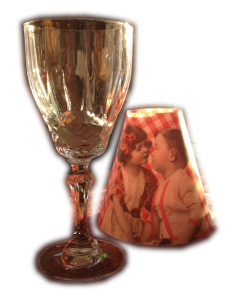
This lamp in particular comes from French retailer Orval Creations, who market themselves as purveyors of retro vintage decor.
You can see that all it is, is a plastic shade, placed over crystal stemware. What makes it easy to ship, however, is that it comes flat, and you just wrap it into shape.
*see the un-assembled lampshade below*
You can purchase a set of 3 such lampshades for only 3.81 euros ($5.25)…. the only problem is… they will only ship within Europe, so impossible to order directly from their site if you’re in North America.
What to do?
Make your own!
You’ll want to find something that’s rigid enough to hold it’s shape well… a craft supply store would likely have something to fit the bill.
The lampshades shown here have a pattern and graphics on them, however they can just as easily be plain as well (as is the case on the very swanky river cruise).
DIY stemware lampcovers:
- Save-on-Crafts.com
- Postris (they suggest a paper-cup with a cool design and the bottom cut out of it, turned upside down on stemware).
*Note:*
If using paper cups, use the LED tealights… NOT real candles, as the paper cups could catch fire… and nothing kills the romance like having to blast the room with foam or fire-suppressing powder!

Bonne Chance!
(good luck!)
Shapely Trees
For this third post in the Experience it series we’re going to head out into the Garden and give you a couple of ideas that will help you bring a little bit of France into your yard. Continue reading
 AIM Long